Skip to content

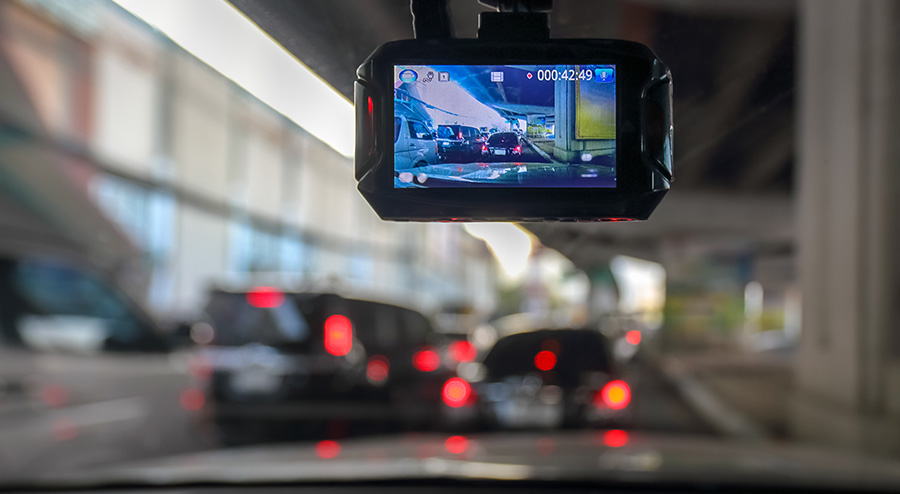
Dashcams are rapidly gaining popularity in Quebec. Once reserved for truck drivers, taxi drivers, and car enthusiasts, they are now found in a growing number of personal vehicles.
But beyond their technological aspects, do these small cameras serve a real purpose? Can they influence the settlement of an auto insurance claim? Are they just a gadget, or a real ally in the event of an accident?
The answer might surprise you.
What is a dashcam?
A dashcam is a small camera installed inside the vehicle, usually behind the rearview mirror. It continuously records what’s happening on the road while you’re driving.
Some models film only forward, while others offer a front-and-rear view or even monitor the interior of the vehicle. Many devices can also record speed, GPS location, and detect impacts even when the vehicle is parked.
Why are more and more drivers using them?
The main reason is simple: to have objective evidence when an incident occurs.
After a collision, the accounts of the drivers involved may sometimes differ. Witnesses aren’t always present, and memories can be inaccurate due to stress.
A video can then clearly demonstrate:
- Who had the right of way;
- Whether a traffic light was red or green;
- Whether a driver made a dangerous maneuver;
- The exact circumstances of the accident;
- The behavior of other road users.
In many situations, just a few seconds of footage can prevent lengthy disputes.
Useful Evidence for Your Insurer
When a claim is filed, the insurer must establish the circumstances of the event to determine liability.
A dashcam video can provide valuable information that helps:
- Speed up the review of the case;
- Confirm the reported facts;
- Support the insured’s account;
- Identify a liable third party;
- Limit certain disputes.
Of course, the video does not replace a police report when one is required, but it can serve as particularly compelling evidence.
Imagine that a driver suddenly changes lanes and causes a collision, then claims that you are at fault. If your camera captured the entire scene, the situation becomes much easier to clarify.
Can it lower your insurance premium?
Contrary to popular belief, owning a dashcam does not generally result in an automatic reduction in your auto insurance premium.
Insurers primarily evaluate factors such as:
- Your driving record;
- Your claims history;
- The type of vehicle;
- Your place of residence;
- The vehicle’s use.
However, a dashcam can indirectly protect you against certain unjustified claims or make it easier to prove you weren’t at fault in an accident.
In the long run, this could help preserve your driving record and avoid certain financial consequences associated with an accident for which you were wrongly held responsible.
What about hit-and-run accidents?
Dashcams can also be very useful when a vehicle is damaged while parked.
Some models are equipped with a surveillance mode that activates when an impact is detected. If another driver hits your vehicle and leaves the scene, the camera could record:
- The vehicle involved;
- The license plate number;
- The direction the driver took;
- The exact time of the incident.
Although image quality varies depending on lighting conditions and the model used, this information can sometimes make all the difference.
A Few Limitations to Be Aware Of
A dashcam is not a miracle solution.
First, image quality depends largely on the model you choose. An entry-level camera might not allow you to clearly distinguish certain important details.
Second, weather conditions, darkness, or a dirty windshield can reduce the effectiveness of the recordings.
It’s also important to remember that a video can sometimes show shared liability or even confirm that the driver who owns the camera made a mistake. The camera records the facts as they happen, without bias.
What about privacy?
In Canada, the use of a dashcam in a personal vehicle is generally permitted.
However, it is recommended that recordings be used solely for their primary purpose: documenting events related to driving and road safety.
Posting videos on social media or sharing images in which people can be identified raises other privacy concerns.
So, is it just a gimmick or a goldmine of evidence?
For many drivers, the dashcam has become the modern equivalent of an impartial witness always on board.
It doesn’t prevent accidents or replace safe driving. However, when an incident occurs, it can provide valuable evidence that facilitates the processing of a claim and helps establish the facts.
Given the relatively affordable cost of many models currently available on the market, it’s an investment that many drivers view as providing added peace of mind.
Because when it comes to auto insurance, a few seconds of video can sometimes be worth much more than a long debate.